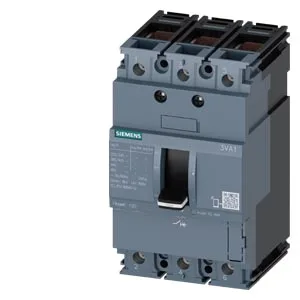
What this MCCB carries — and where it fits
The Siemens SENTRON 3VA1080-4ED36-0CC0 is a 3-pole molded case circuit breaker (MCCB) rated for 80 A at 40 °C, with a breaking capacity of 121 kA at 240 V AC. That 121 kA figure means it can safely interrupt a fault current up to that level without welding its contacts or cascading the arc upstream — critical for high-fault panels near large transformers or motor control centers. The line-protection design suits it for feeder circuits where you need selective coordination downstream of a main breaker. Insulation voltage is rated at 800 V. Power loss maxes at 21.7 W.
Breaking capacity across the voltage range
This breaker's interrupting rating drops as voltage climbs: 121 kA at 240 V, 75.6 kA at 415 V, 52.5 kA at 440 V, and 11.9 kA at both 500 V and 690 V (–). For a 480 V panel, you've got 52.5 kA of fault-clearing headroom — enough for most industrial services. The 11.9 kA at 690 V still covers standard motor branch circuits on 690 V systems.
Thermal derating — what it means on a hot panel
Rated current holds flat at 80 A from 40 °C through 50 °C (–). At 55 °C it derates to 78 A, at 60 °C to 77 A, at 65 °C to 75 A, and at 70 °C to 74 A (–). If this breaker sits near a motor starter or a drive in a non-ventilated enclosure, that 74 A at 70 °C is the number to size against — not the 80 A nameplate. Operating range spans -25 °C to 70 °C (–), storage from -40 °C to 80 °C (–).
Built-in undervoltage release and auxiliary switches
This order code includes an undervoltage release (UVR) — it trips the breaker if supply voltage drops below a threshold, which is standard for safety circuits that need to drop a motor feeder on loss of control power. It also carries two auxiliary switches (HQ design) for remote status indication. No communication function, no ground-fault monitoring, and no trip indicator — it's a straightforward line-protection MCCB with UVR and aux contacts. Dimensions: 130 mm height, 76.2 mm width, 70 mm depth.
