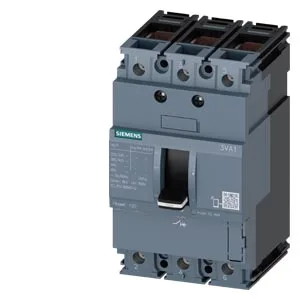
What this MCCB is and what it does
The Siemens 3VA1080-4ED36-0HH0 is a SENTRON molded case circuit breaker (MCCB) designed for line protection — meaning it sits at the feeder or subfeeder to protect cables and busbars from overloads and short circuits, not a specific motor or device. Rated 80 A at 40 °C and carrying a 3-pole construction, it fits standard distribution panels and switchboards. The 121 kA breaking capacity at 240 V tells you it can interrupt very high fault currents without welding contacts or venting gas into adjacent gear — critical for high-capacity transformer secondaries or busway drops where available fault current is high.
Breaking capacity — the number that decides coordination
This MCCB delivers 121 kA at 240 V, 75.6 kA at 415 V, 52.5 kA at 440 V, and 11.9 kA at both 500 V and 690 V. The steep drop above 500 V is typical for a compact-frame MCCB — at 690 V the 11.9 kA figure still covers most industrial distribution, but you need to verify it exceeds the prospective short-circuit current at the point of installation. The insulation voltage is rated 800 V, so the breaker itself is safe on 690 V systems; the limitation is purely interrupting capability.
Thermal derating and ambient temperature
The 80 A rating holds flat from 40 °C through 50 °C. Above that it derates: 78 A at 55 °C, 77 A at 60 °C, 75 A at 65 °C, and 74 A at 70 °C. If the panel ambient runs above 50 °C — say a sealed enclosure near a furnace line — you lose roughly 6 A by 70 °C. The operating temperature range is -25 °C to 70 °C, so it handles cold starts in unheated plant areas. Maximum power loss is 19.2 W, which matters for thermal rise calculations in a multi-breaker panel.
Auxiliary switches and shunt trip — what ships inside
This variant comes factory-fitted with 2 auxiliary switches plus 1 trip alarm switch (HQ type), and a shunt trip release (STL). The auxiliary switches give remote status of the breaker position (open/closed); the trip alarm signals that the breaker tripped on fault, not manual operation. The shunt trip lets a remote pushbutton or PLC output open the breaker — useful for emergency-stop circuits or interlocking with a fire-alarm panel. No undervoltage release and no ground-fault monitoring on this order code.
