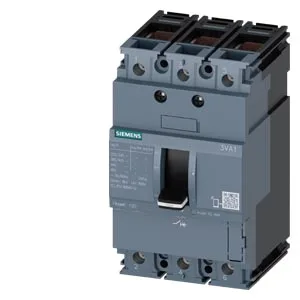
At 415 V it still handles 75.6 kA, and at 690 V it drops to 11.9 kA — the lower voltage networks are where this breaker earns its keep. Above 55 °C it begins to taper: 76.8 A at 55 °C, 75.2 A at 60 °C, 73.6 A at 65 °C, and 72 A at 70 °C.
Overcurrent release and auxiliary options
The overcurrent release is the TM210 — a thermal-magnetic design, meaning the thermal bimetal handles overloads (slow trip) and the magnetic coil handles short circuits (instantaneous). No electronic adjustment, no communication module, no phase-failure detection. This is a straightforward, field-reliable breaker for fixed-load feeders where you don't need remote monitoring or adjustable trip curves. No undervoltage release, no auxiliary contacts, no ground-fault monitoring.
The 76.2 mm width is a 3-pole frame; it occupies three 25.4 mm (1-inch) module positions on a DIN rail, which is the standard footprint for SENTRON 3VA breakers. No trip indicator on the front, so fault indication is by breaker position only.
With 121 kA at 240 V and 75.6 kA at 415 V, this breaker can serve as a main or a large feeder in a selective coordination study. The high interrupting capacity means it can be placed upstream of lower-rated breakers, provided the let-through energy is coordinated. The TM210 release gives a fixed magnetic pickup; for full selectivity curves, consult the Siemens selectivity tables for the 3VA series.