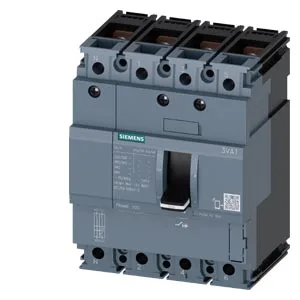
At 40 °C ambient it carries a continuous 80 A per pole; the thermal-magnetic trip curve holds that rating steady up to 50 °C, then begins a gentle derate to 74 A at 70 °C. The interrupting capacity at 240 V AC is 121 kA, dropping to 75.6 kA at 415 V, 52.5 kA at 440 V, and 11.9 kA at 500 V and 690 V — so it is sized for high-fault secondary distribution where the available short-circuit current is substantial. Built into the breaker is an undervoltage release (UVR) — the auxiliary release type listed as undervoltage release (UVR) — which automatically opens the breaker when the supply voltage drops below a threshold. This is standard for applications where a brownout or loss of control power must trip the load (e.g., machine safety circuits or process interlocks). The breaker also carries two auxiliary switches (HQ type) for remote status indication.
The 3VA1080-4ED42-0CC0 measures 101.6 mm wide, 130 mm tall, and 70 mm deep — a compact 4-pole footprint that fits standard DIN-rail or screw-fixed mounting in a distribution panel.