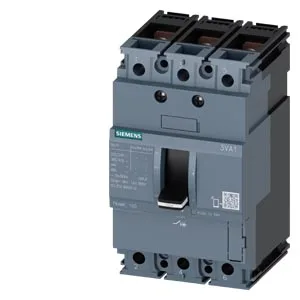
The 75.6 kA interrupting rating at 240 V tells you it can handle high available fault current on a 240 VAC panel bus; at 415 V that drops to 52.5 kA, and at 690 V it's 7.5 kA — still enough for most industrial service entrances but you'll want to check the point-of-fault current against the voltage you're actually running.
At 55 °C it's 15.36 A, at 60 °C it's 15.04 A, at 65 °C it's 14.72 A, and at 70 °C it's 14.4 A. The TM210 release is thermal-magnetic, so it handles overloads with a bimetal curve and short circuits with a solenoid — no electronic adjustment, no communication, no ground-fault monitoring. That keeps it simple and reliable for fixed-load distribution. It carries an undervoltage release (UVR) as standard — if control voltage drops, the breaker trips. The integrated auxiliary trip is order code 3VA9608-0BB11 — that's the specific accessory that mates with this frame.
Panel integration
The 76.2 mm width means it takes three 25.4 mm module spaces — standard for a 3-pole MCCB. The undervoltage release coil draws from the control circuit; verify the control voltage matches your system before wiring. The auxiliary contacts and trip alarm share a common terminal block; wire the trip alarm to a PLC input or annunciator for remote fault indication.