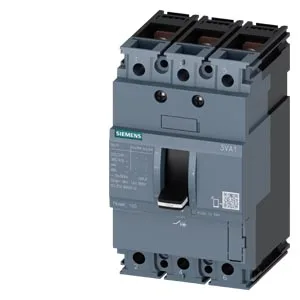
It carries a 16 A rating at 40 °C ambient and a 75.6 kA interrupting capacity at 240 V AC — enough to handle high-fault utility feeds or transformer secondaries without cascading upstream. The shunt trip (STL) auxiliary release lets a remote signal (emergency stop, fire alarm, undervoltage relay) open the breaker independently of the overcurrent mechanism.
The 16 A continuous rating holds across 40 °C to 55 °C without derating; at 60 °C it drops to 15 A, and at 70 °C it's still 15 A. That's a tight thermal curve — useful in a warm enclosure where a standard 16 A breaker would start nuisance-tripping. The interrupting ratings step down with voltage: 75.6 kA at 240 V, 52.5 kA at 415 V, 32 kA at 440 V, and 7.5 kA at 500 V and 690 V. The TM210 release is a fixed thermal/fixed magnetic design — no adjustable trip, which simplifies spec but means you pick the exact frame for the load.
Dimensions are 130 mm high, 76.2 mm wide, 70 mm deep — standard 3-pole MCCB footprint for a 16 A frame. The shunt trip adds a pair of control terminals; verify coil voltage matches your control circuit (the order code doesn't specify voltage, but the STL release is typically 110–240 V AC/DC — confirm on the nameplate).