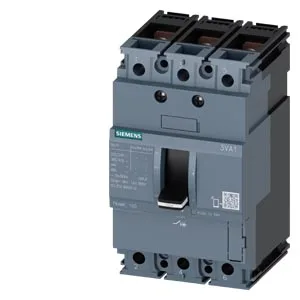
It's a line-protection unit, not a motor-protection or ground-fault version, so it's sized for feeder and distribution circuits where you need a hard 16 A threshold and high interrupting capacity. The 121 kA at 240 V and 75.6 kA at 415 V tell you it can handle high-fault locations like a main distribution panel or a tap feeding a high-capacity busway.
This MCCB's interrupting rating drops as system voltage rises — standard for any breaker. At 240 V it clears 121 kA; at 415 V it's still 75.6 kA; at 440 V it's 52.5 kA; at 690 V it's 11.9 kA. For a 16 A frame, those numbers are high — it's not a standard 10 kA or 18 kA branch breaker.
Thermal derating and panel temperature
At 55 °C it derates to 15.36 A, at 60 °C to 15.04 A, at 65 °C to 14.72 A, and at 70 °C to 14.4 A.
The breaker measures 70 mm deep, 76.2 mm wide, 130 mm tall — a standard 3-pole MCCB footprint that fits most DIN-rail or panel-mount enclosures. The IP40 front protection means it's suitable for indoor panel installation where no washdown or dust ingress is expected. The undervoltage release (UVR) is built in; the two HQ auxiliary switches provide remote status feedback without needing an extra accessory slot. No communication module or ground-fault monitoring is fitted — this is a straightforward line-protection breaker with basic signalling.