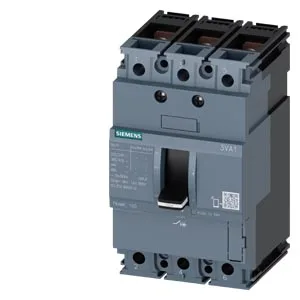
16 A MCCB with 121 kA interrupting capacity — what that means on the line
At 415 V it still clears 75.6 kA, and at 690 V it holds 11.9 kA, so it is sized for high-fault panels where upstream transformers or utility feeds can dump serious energy into a bolted fault. Thermal element handles overloads on an inverse-time curve; the magnetic element catches short-circuits instantaneously. That keeps the bill of materials simple and the panel build predictable, but it also means you commit to the 16 A rating at ordering — no field re-rating. An undervoltage release (UVR) is fitted as standard on this variant — part of the auxiliary release design. Useful for safety circuits where a loss of control power should also kill the load. No auxiliary contacts, no shunt trip, no ground-fault module on this build.
At 55 °C it derates to 15.36 A, at 60 °C to 15.04 A, at 65 °C to 14.72 A, and at 70 °C to 14.4 A. If this breaker lives in a crowded panel or next to a heat source, the 55 °C figure is the one to size against — a 16 A breaker at 55 °C is really a 15.36 A breaker.
The 3VA1096-4ED32-0CA0 measures 76.2 mm wide by 130 mm high by 70 mm deep.