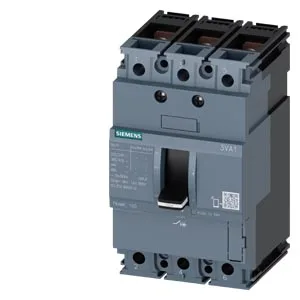
It carries a 16 A rating at 40 °C and delivers a 121 kA interrupting capacity at 240 VAC — that means it can safely clear a fault up to 121,000 amps at that voltage without welding contacts or rupturing the case, which is the figure that determines whether it holds up under a bolted fault on a high-capacity transformer secondary. The TM210 overcurrent release combines a thermal bimetal for overload protection and a magnetic coil for short-circuit response. A built-in shunt trip (STL) allows remote tripping from a PLC or emergency-stop circuit — useful when you need to kill power to a panel section without pulling the handle.
Interrupting rating drops as system voltage rises: 75.6 kA at 415 V, 52.5 kA at 440 V, and 11.9 kA at both 500 V and 690 V. For a 480 V panel in North America, the 52.5 kA at 440 V is the relevant benchmark — derate slightly for the 480 V actual, but it still comfortably covers most industrial service-entrance requirements.
Rated 16 A continuously from 40 °C to 55 °C ambient. At 60 °C it derates to 15 A, and holds there through 70 °C. That flat derating curve means you don't lose headroom until the panel interior runs hot — typical for a sealed enclosure near a furnace line or in a poorly ventilated MCC room. The 3-pole width (76.2 mm) is standard for this frame size — it fits the same DIN-rail or mounting-plate footprint as other SENTRON 3VA breakers in the same current class.