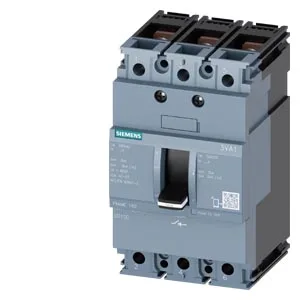
It carries no overload or short-circuit protection elements, so it functions purely as a manually operated load-break isolator for a circuit that is already protected upstream or downstream by a separate overcurrent device. Rated insulation voltage (Ui) is 800 V, with maximum operational voltage 690 V AC 50/60 Hz and 500 V DC. The 100 A rating and 3-pole configuration suit it for isolating three-phase motor feeders, panel incoming sections, or distribution sub-circuits where a visible break is required for lockout/tagout. Four HQ auxiliary contacts (4 CO) are built in, giving status feedback for PLC inputs or panel indication without needing a separate aux block.
What the 100 A rating means for fit
For a switch disconnector, the key distinction from a circuit breaker is that this part is designed to make and break load currents (up to its rated operational voltage) but not to interrupt fault currents. It is sized for the full-load current of the downstream load, not for available fault current. The 2 kA limited short-time withstand (1 s and 0.5 s ratings) confirms it can survive a fault current of that magnitude for the stated duration while the upstream protective device clears — typical for a downstream isolator in a selectively coordinated distribution system.
The 3VA1110 frame shares the same 70 mm depth, 76.2 mm width, and 130 mm height as other 3VA1 IEC frame 160 three-pole devices. The front terminal arrangement accepts busbar connection with the included nut keeper kit — no lug or box terminal conversion needed for busbar feed. Maximum power dissipation at rated current is 38 W — account for this in panel thermal calculations if the switch is enclosed with other heat sources.