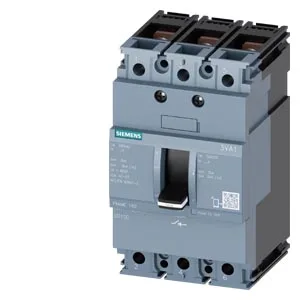
It provides no overload or short-circuit protection — it is a disconnect-only device, intended for isolation and switching duty where the upstream protection curve is handled separately. Rated operational voltage reaches 690 V AC 50/60 Hz and 500 V DC, so it covers common 400 V three-phase distribution as well as DC bus circuits up to 500 V. Short-time withstand is 2 kA at both 0.5 s and 1 s intervals — enough for fault clearing coordination with upstream breakers in a typical industrial panel.
The 100 A continuous rating (Iu) sets the maximum load current the switch can carry without exceeding its thermal limits. For motor circuits, size it to the full-load current of the motor plus any continuous auxiliary loads; for resistive or general distribution, it handles the full 100 A bus. Mechanical endurance is 15 000 operating cycles. Maximum power loss is 38 W at rated current.
This switch disconnector is used in distribution boards where upstream protection is already provided. The front-terminal busbar connection suits panel layouts.
The 70 mm depth, 76.2 mm width, and 130 mm height match the standard 3VA1 frame dimensions shared with the MCCB variants in this series. If a panel was originally designed around a 3VA1 MCCB, this disconnector occupies the same footprint and mounting pattern — no rewiring or panel modification needed for the swap.