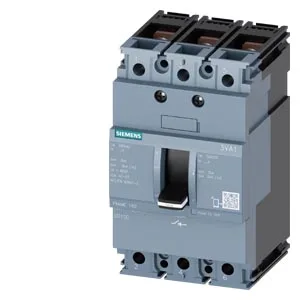
Switch disconnector, not a breaker — know the difference
The Siemens 3VA1110-1AA32-0CH0 is a SENTRON 3VA1 IEC frame 160 switch disconnector rated 100 A continuous (Iu) — it provides visible isolation and load-break capability but carries no overload or short-circuit protection. This is the key distinction from the MCCB variants in the same 3VA family: the product designation is "Switch disconnector" and the description explicitly states "without overload protection w/o short-circuit protection." If your BOM calls for a disconnecting means upstream of a downstream protective device, this fits. If you need integrated overcurrent protection, you want the line-protection version (e.g., 3VA1110-5EE32-0DC0). Rated for 690 V AC (50/60 Hz) and 500 V DC maximum operational voltage, the 3-pole unit handles both AC and DC isolation duties. The 2 kA limited short-time rating (1 s and 0.5 s) confirms it can withstand fault current for coordination intervals — not interrupt a fault, but hold closed during a downstream breaker's clearing time.
Undervoltage release and auxiliary contact complement
The UVR has no leading contact, meaning it does not provide early break signaling to a downstream device. The HQ designation indicates high-rupturing-capacity contacts suitable for switching control transformer or PLC input loads directly. The trip alarm switch changes state only when the switch disconnector trips via the UVR or manual operation, giving a positive status signal for the safety circuit.
Mounting and connection — busbar front-terminal design
The main current circuit connects via busbar connection at the front terminals — this is a lug-style interface for bolted busbar or cable lugs, not a plug-in or rear-connect design. Dimensions are 70 mm deep × 76.2 mm wide × 130 mm high, matching the standard 3VA1 frame 160 footprint.