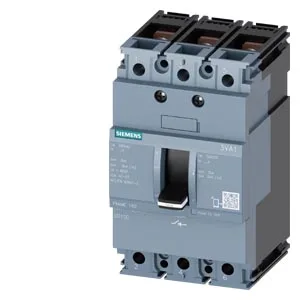
It is built for isolation and switching duty without overload or short-circuit protection — a pure disconnect, not a circuit breaker. Rated continuous current Iu is 100 A. Voltage ratings cover 690 V AC 50/60 Hz and 500 V DC — enough for most industrial 400 V AC panels and 500 V DC battery or PV circuits.
The 2 kA limited short-time withstand at 1 s and 0.5 s tells you this is a switch disconnector meant for isolation behind an upstream protective device — not a breaker that interrupts faults itself. It must be coordinated with a fuse or MCCB ahead of it that clears faults within that 2 kA window. This allows remote tripping from a safety relay, PLC output, or emergency-stop circuit. No undervoltage release is fitted — the unit stays closed on loss of control power unless the shunt trip is actively triggered. The auxiliary contact block includes 2 form-C auxiliary switches plus 1 dedicated trip alarm switch (HQ). That gives three independent signal paths: two for status feedback (open/closed) and one that changes state only when the disconnect trips via the shunt release — useful for remote alarm annunciation. Front terminal busbar connection means the main circuit connects via busbar stabs or plug-on adapters, not lugs. This is the standard interface for panelboard or switchboard mounting where the disconnect plugs onto a vertical bus. Suitable for indoor panel installation; not for washdown or outdoor enclosures without additional cabinet sealing.