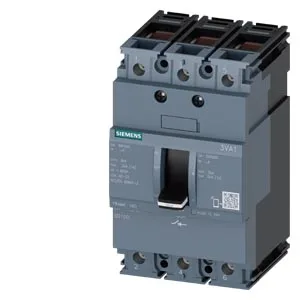
The Siemens SENTRON 3VA1110-1AA36-0BC0 is a 3-pole switch disconnector built in an MCCB-style housing (IEC frame 160) rated for 100 A continuous at 690 V AC or 500 V DC. It is a pure disconnecting means — no overload or short-circuit protection elements inside — so it functions as a manual load-break switch for isolating a circuit under load, not as a circuit breaker.
Undervoltage release and auxiliary switches
This variant ships with a factory-fitted undervoltage release (UVR) coil rated for 24 V DC. The UVR does not include a leading contact, so the release coil and main contacts do not have a sequenced make/break relationship.
The housing measures 130 mm high, 76.2 mm wide, and 70 mm deep — a standard 3-pole MCCB footprint that fits most DIN-rail or panel-mount enclosures without surprises. Main circuit connections are front terminals (clamp type) accepting copper conductors; the front-access layout means the switch can be butted against adjacent devices on a busbar system without blocking wiring access.
Thermal and electrical limits
Maximum power dissipation at rated current is 38 W — a relevant number for enclosure thermal calculations when multiple disconnectors are ganged. Mechanical endurance is 15,000 operating cycles typical; no electrical endurance figure is listed, so cycle life under load depends on the switched current and voltage.
What it does not include
No trip indicator, no voltage-trip function, no communication interface, and no motor drive are fitted as standard — though the housing accepts an optional motor-drive extension for remote switching. The switch is not a circuit breaker; it provides no overcurrent or short-circuit protection downstream. For those functions, a 3VA MCCB or fuse combination must be added upstream.