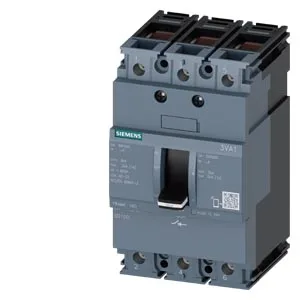
Switch disconnector for isolation duty
It provides visible-break isolation without overload or short-circuit protection — the circuit protection is handled upstream or by a separate device. The 3-pole unit carries a maximum AC operating voltage of 690 V (50/60 Hz) and a DC operating voltage of 500 V, making it suitable for both AC motor branch circuits and DC bus isolation in industrial panels.
Undervoltage release and auxiliary contacts
The UVR does not include a leading contact, so the disconnector opens without a time delay ahead of the main contacts. The trip alarm switch changes state only when the disconnector trips via the UVR or a manual operation, not on normal switching — useful for remote fault annunciation.
Dimensions are 130 mm height, 76.2 mm width, and 70 mm depth — the same footprint as the 3VA1 line-protection MCCBs (e.g., 3VA1110-5ED36-0AC0), so it drops into the same panel cutout and busbar arrangement without rewiring. Front-terminal clamp connections accept copper conductors up to the frame rating. Front-face protection is IP40, adequate for enclosed panel mounting where tools or fingers cannot reach live parts.
Short-time withstand and endurance
The disconnector is rated for 2 kA short-time withstand current at both 0.5 s and 1 s intervals. This is not a breaking capacity — the device is not designed to interrupt fault currents — but it must survive the let-through energy of an upstream protective device until that device clears. Verify coordination with the upstream breaker or fuse. Mechanical endurance is 15,000 operating cycles (latching endurance). That is typical for a switch disconnector in MCCB form factor and sufficient for most isolation applications where the device is operated a few times per shift, not continuously.