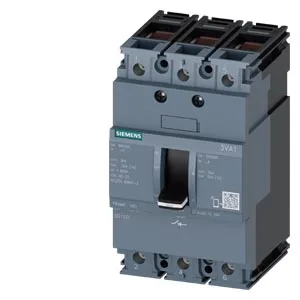
This is a pure disconnect — no overload or short-circuit protection built in, so it's specified as a manual load-break switch or isolator, not a circuit breaker. The integrated shunt trip (STL) accepts 12-30V DC or 24V AC 50/60 Hz for remote tripping, which is the main interface for emergency-off or supervisory control circuits.
Rated continuous current Iu is 100 A — this is the thermal current the main contacts carry continuously without exceeding the 70 °C maximum operating ambient. Short-time withstand current is 2 kA at both 0.5 s and 1 s — that's the fault current the closed contacts can tolerate without welding, relevant for coordination studies where upstream protection clears a fault before the disconnect opens. Power loss is 38 W maximum at rated current — a figure to check for enclosure thermal rise, especially in a sealed panel. Front protection is IP40, meaning tool-accessible terminals only; the body is not sealed against washdown.
Panel integration
Dimensions are 130 mm height, 76.2 mm width, 70 mm depth — a compact 3-pole footprint that fits standard DIN-rail or panel-mount layouts for IEC frame 160 devices. Main circuit connections are front terminals with clamp-type (screw) termination, so wiring access is from the front without side clearance. The shunt trip coil is wired separately; no auxiliary contacts are included (0 CO contacts), so if status feedback is needed, an external auxiliary switch block must be added.