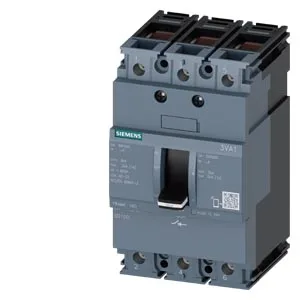
The Siemens 3VA1110-1AA36-0JC0 is a SENTRON 3VA1 switch disconnector in MCCB design — a 3-pole, 100 A rated continuous current (Iu) device on the IEC frame 160 platform. It is built for isolation and switching duty, not for overload or short-circuit protection: there is no overcurrent release inside this variant. The part carries a shunt trip (STL) release rated for 110-127 V DC and AC 50/60 Hz, plus two HQ auxiliary switches (2 CO contacts). Rated operational voltage goes up to 690 V AC and 500 V DC. The front terminal connection accepts clamp-type conductors.
The 100 A continuous rating (Iu) sets the maximum current the main contacts can carry without exceeding temperature limits. This is a switch disconnector, so it is sized for load-break and isolation duty at that current level — not for fault interruption. The short-time withstand ratings (2 kA for 1 s and 2 kA for 0.5 s) tell you the device can survive a fault current of that magnitude for that duration while remaining closed, which matters for selectivity coordination downstream of a higher-rated breaker. The shunt trip (STL) release allows remote tripping by applying 110-127 V DC or AC to the release coil. This is a common requirement for emergency-stop circuits or remote shutdown schemes where the disconnect must open on command from a safety relay or PLC output. Maximum power loss is 38 W at rated current — this is the heat the device dissipates into the enclosure. Panel designers should account for this when sizing ventilation or calculating internal temperature rise, especially in a sealed cabinet with multiple devices.