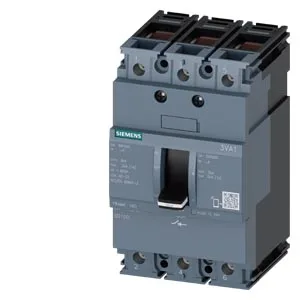
It is not a circuit breaker — it carries no overload or short-circuit protection elements. Its job is safe isolation under load, not fault interruption. The 100 A rating means it can make and break full-load current for motor circuits, panel feeders, or distribution branches where you need a visible disconnect point, not overcurrent protection.
Rated continuous current Iu is 100 A — this is the maximum current the disconnector can carry continuously without exceeding its thermal rise limits. The max rated operational voltage is 690 V AC 50/60 Hz and 500 V DC, so it covers standard 400 V three-phase panels and many DC bus applications up to 500 V. The shunt trip release (STL) operates on 220-250 V DC or 208-277 V AC. That covers common control voltages in North American (208/277 V) and European (230 V) panels. The disconnector can be tripped remotely via this release — useful for emergency stop circuits or remote shutdown sequences. No undervoltage release is fitted, and no auxiliary contacts come standard. Mechanical endurance is 15,000 operations. The front terminal connection accepts lug-type conductors, and the optional motor drive extension means it can be motorized.
The 3VA1110-1AA36-0KA0 mounts on a DIN rail or panel — the 70 mm depth, 76.2 mm width, and 130 mm height fit the standard 3VA1 frame footprint. The front terminal arrangement keeps wiring accessible for panel builders, and the lug-type connection accepts conductors up to 17 x 6.5 mm cross-section.