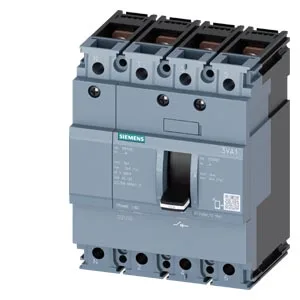
The Siemens SENTRON 3VA1110-1AA42-0AC0 is a 4-pole switch disconnector in an MCCB-style housing, rated for 100 A continuous at any temperature from 40 °C through 70 °C — no derating needed across that entire span. This is a pure disconnector — it provides no overload or short-circuit protection. The absence of a trip indicator, undervoltage release, and voltage trigger confirms it is intended solely for isolation and switching under load, not for circuit protection. The main circuit connects via busbar connections at front terminals, which means it mounts into a panel bus system rather than accepting individual cable lugs. An optional motor drive can be added for remote operation.
The 3VA1110-1AA42-0AC0 occupies a 101.6 mm wide, 130 mm tall, 70 mm deep footprint — the same depth as the 3-pole variant in the same frame, so a panel drilled for a 3-pole 3VA1 will accept this 4-pole unit without re-drilling the mounting plate. Front terminals mean all wiring is accessible from the front; no rear access needed. IP40 on the front protects against tools and small objects; the rest of the device relies on the enclosure for environmental sealing.
The closest functional peer is the 3VA1110-5ED36-0AC0, a 3-pole molded case circuit breaker with thermal-magnetic protection (TM210, LI characteristic) rated for 100 A at 40 °C. That part provides overload and short-circuit protection; this disconnector does not. The disconnector uses busbar connections; the MCCB uses box terminals on both sides. The MCCB has a higher mechanical life (20,000 cycles vs 15,000) and lower power loss (25 W vs 38 W). The disconnector carries a higher DC voltage rating (600 V vs 500 V). If your BOM calls for a 4-pole disconnector without protection, this is the correct part. If you need overcurrent protection in the same frame, the 3VA1110-5ED36-0AC0 is the MCCB equivalent — but it is 3-pole only, so a 4-pole application requires a different solution.