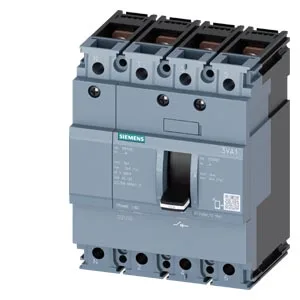
That flat thermal curve is unusual; most MCCB-frame switches start pulling current back above 40 °C. This one holds 100 A all the way to 70 °C. Rated for 690 V AC and 600 V DC operation, with an insulation voltage of 800 V, it handles line-to-line isolation on 400 V and 480 V distribution panels cleanly. The auxiliary switches are factory-fitted and wired to the front terminal arrangement, which uses busbar connection for the main circuit — so it drops onto a standard SENTRON busbar system without extra adapters.
Power loss is 38 W maximum at rated current, which matters for thermal management inside a sealed enclosure.
Dimensions are 70 mm deep, 101.6 mm wide, and 130 mm tall — the 101.6 mm width (4 inches) is the standard 4-pole MCCB footprint for the SENTRON 3VA frame 160. The front terminal arrangement with busbar connection means the main power conductors land on the busbar system, not directly on the device — plan for busbar takeoffs in your panel layout.
What it is not — and why that matters
Compared to the 3VA1110-5ED36-0AC0 (a 3-pole MCCB with TM210 trip), this 4-pole disconnector is 25.4 mm wider (101.6 mm vs 76.2 mm) and has a lower mechanical life (15,000 vs 20,000 cycles). The breaker also has a higher power loss (25 W vs 38 W) despite being 3-pole — the disconnector's higher loss reflects the continuous-duty busbar path without a trip mechanism. The two parts are not electrically interchangeable; the disconnector lacks the protection function entirely.