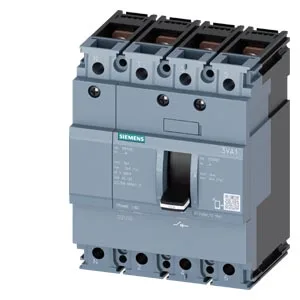
It is built for load-break isolation, not overload or short-circuit protection — that distinction matters when you are filling a BOM line that calls for a disconnect switch, not a breaker. The part carries a 24 V DC undervoltage release and two HQ auxiliary switches, so it can be wired into a safety or control circuit that must drop the load on undervoltage or signal position back to a PLC.
Thermal profile — flat to 70 °C
No derating curve to calculate; the full 100 A is available even at the 70 °C upper ambient limit. That is unusual for an MCCB-frame device and simplifies panel thermal budgeting — you do not need to oversize the disconnect for a hot enclosure.
Integration — what fits where
The disconnect mounts via front terminals with busbar connection for the main circuit. Dimensions are 130 mm height, 101.6 mm width, 70 mm depth — a 4-pole MCCB footprint that fits standard panel layouts for the 160 A frame size. The 38 W maximum power loss needs to be factored into the enclosure thermal calculation.
Auxiliary and control wiring
Two CO (changeover) contacts are built in as HQ auxiliary switches, giving you position feedback without an add-on module. The undervoltage release (UVR) is wired separately at 24 V DC; when the control voltage drops, the UVR trips the disconnect open — a standard safety function for motor feeder isolation. Note that the UVR does not include a leading contact, so the dropout is not delayed relative to the main poles.