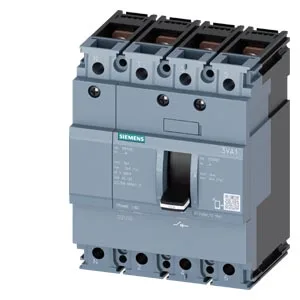
The Siemens 3VA1110-1AA42-0CH0 is a SENTRON switch disconnector built in a molded-case circuit breaker (MCCB) form factor — IEC frame 160, 4-pole, rated 100 A continuous across the full operating temperature range from 40 °C to 70 °C. It is a pure disconnect — no overload or short-circuit protection — so it goes into a circuit where the upstream breaker or fuse handles the fault clearing, and this part provides visible isolation for safe maintenance.
Undervoltage release and auxiliary switch configuration
The UVR does not have a leading contact, so the coil energizes simultaneously with the main contacts; plan the control wiring accordingly if you need the UVR to seal in before the main circuit closes. The auxiliary switch block carries two HQ (high-rupture-capacity) form-C contacts plus one HQ trip alarm switch — three CO contacts total. The trip alarm switch changes state only when the UVR or a manual trip opens the disconnector, giving the PLC a dedicated fault signal separate from the position-feedback aux contacts. That is a clean way to distinguish a deliberate open from a fault-induced open without extra logic in the controller.