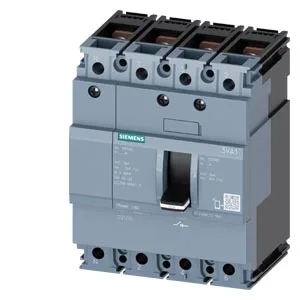
The Siemens 3VA1110-1AA42-0JA0 is a SENTRON switch disconnector built in an MCCB form factor — same frame, same DIN-rail footprint, but with a critical difference: it provides no overload protection and no short-circuit protection. The shunt trip release (STL) rated 110-127 V DC/AC lets you trip it remotely, which is the main reason you'd spec this over a plain handle-operated disconnect.
Max AC operational voltage is 690 V 50/60 Hz, and DC max is 600 V, so it covers 480 V and 600 V AC panels cleanly, and DC bus isolation up to 600 V. Busbar connection on the front terminals means it's designed for horizontal busbar systems typical in switchboard and panelboard builds, not for cable lugs out of the box.
Width is 101.6 mm (4 inches), depth 70 mm, height 130 mm — the 4-pole variant takes up two extra pole spaces compared to the 3-pole 3VA1 siblings, so check your panel cutout and busbar staging before committing. No auxiliary contacts are fitted (0 CO contacts), and no communication module is available on this variant — it's a pure disconnect with remote trip capability.