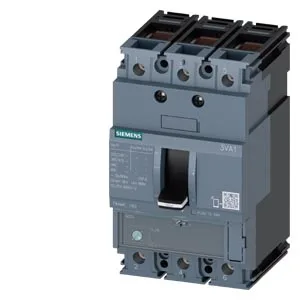
SCCR and Thermal Derating — What the Ratings Mean for Fit
The 3VA1110-3EE36-0BF0: The 75.6 kA interrupting rating at 240 V AC is the headline number, but the real-world fit depends on the system voltage. At 415 V the breaker still clears 52.5 kA, dropping to 32 kA at 440 V and 11.9 kA at 500 V and 690 V. That means it can serve as the main or feeder breaker in a 480 V panel with available fault current up to 11.9 kA, or in a 240 V panel up to 75.6 kA — a wide selectivity window for most industrial distribution. Thermal derating is modest: the breaker holds 100 A from 40 °C through 50 °C, then drops to 98 A at 55 °C, 96 A at 60 °C, 94 A at 65 °C, and 91 A at 70 °C. For a panel running at 50 °C ambient, no derating is needed; at 60 °C you lose 4 A. The rated insulation voltage is 800 V, so the breaker is suitable for 690 V line-to-line systems.
Auxiliary Switch and Undervoltage Release — Built-In
This variant ships with one auxiliary switch and one trip alarm switch (HQ type) plus an undervoltage release (UVR) as the auxiliary release. The UVR will trip the breaker when control voltage drops below a set threshold — useful for motor feeder circuits where loss of control power should open the main contacts. The auxiliary switch provides a remote status signal for the PLC or SCADA system. No communication function is included; this is a standalone breaker.
Panel Integration — Footprint and Mounting
The breaker measures 130 mm high, 76.2 mm wide, and 70 mm deep. That 3-inch width is a standard MCCB footprint for a 3-pole 100 A frame — it fits the typical DIN-rail or panel-mount cutout used across the SENTRON 3VA family. Operating temperature range is -25 °C to +70 °C, storage from -40 °C to +80 °C. Maximum power loss is 27.5 W, which should be factored into the enclosure thermal budget.
