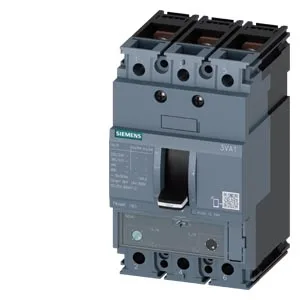
Interrupting capacity is specified at multiple system voltages: 75.6 kA at 240 V, 52.5 kA at 415 V, 32 kA at 440 V, and 10.5 kA at 690 V. That spread covers common low-voltage distribution levels from North American 240 V delta through European 400/415 V networks up to 690 V industrial supplies. Thermal derating is minimal through 50 °C (still 100 A), then drops to 96 A at 55 °C, 94 A at 60 °C, 92 A at 65 °C, and 90 A at 70 °C. For a panel that runs warm — say a packed enclosure with drives — the 90 A floor at 70 °C means you don't oversize the breaker for ambient heat; the 100 A frame handles the same load as a cooler panel would. The enclosure footprint is 70 mm deep, 76.2 mm wide, 130 mm tall — a standard 3-pole MCCB form factor that fits most DIN-rail or panel-mount layouts.
Auxiliary contacts and release options
This variant ships with three auxiliary switches (HQ type) integrated, providing status feedback for remote monitoring or PLC inputs. It does not include an undervoltage release, a shunt trip (voltage trigger), or a ground-fault monitoring module — those are separate add-on accessories that mount to the breaker's accessory slots. The TM240 release is fixed; no adjustable thermal or magnetic settings are available on this version. No communication module is fitted, so this is a standalone breaker — no remote trip indication or load-shedding via fieldbus. For applications requiring remote control or energy metering, look at the 3VA1 variants with communication options.