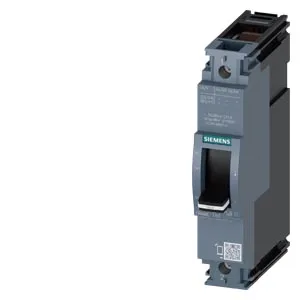
The Siemens 3VA1110-3EF32-0CC0 is a 3-pole IEC molded case circuit breaker on the 3VA1 frame, sized at 160 A frame with a 100 A continuous current rating (In). The headline breaking capacity is 25 kA at 415 V AC — that's the Icu (ultimate short-circuit breaking capacity) under IEC 60947-2, meaning it can safely interrupt a fault up to 25,000 amps at that voltage without welding contacts or rupturing the case. For a panel feeding a motor control center or a distribution board downstream of a transformer in the 400 V class, 25 kA at 415 V is solid class-N headroom; it coordinates with upstream gear rated 36 kA or 50 kA without forcing a bigger frame. The TM240 thermal-magnetic trip unit gives adjustable overload protection (Ir) from 70 A to 100 A, and short-circuit pickup (Ii) adjustable from 5 to 10 times In — so on a 100 A setting, the magnetic trip fires between 500 A and 1000 A. That range lets you dial in selectivity with downstream 10 A or 16 A branch breakers on a lighting or small-motor panel.
Deployment context — where this lives in a panel
In a typical 600 mm wide enclosure you can fit a main breaker like this plus several smaller branch breakers and a contactor bank. The UVR coil draws continuously when the line voltage is present; if the control voltage drops below about 85% of rated (around 102 V for the 120 V tap), it trips the breaker open — standard for emergency-stop or undervoltage protection schemes where you want the load to drop on a brownout.