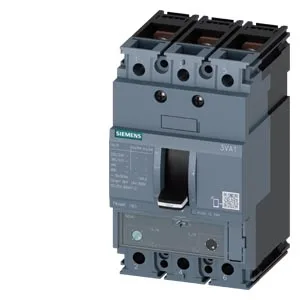
It carries a continuous current rating of 100 A at 40 °C, derating to 91 A at 70 °C, so the 100 A mark holds across most standard panel ambient conditions up to 50 °C before you need to consult the thermal curve. The auxiliary switches report the breaker state back to a PLC or status lamp without needing an add-on block.
Interrupting capacity — what the voltage columns mean
This MCCB's interrupting capacity is specified per voltage level, which is how the SCCR (short-circuit current rating) gets applied in a panel. At 240 V it clears 75.6 kA; at 415 V it clears 52.5 kA; at 440 V it clears 32 kA; at 500 V and 690 V it clears 11.9 kA.
Footprint is 70 mm deep, 76.2 mm wide, 130 mm tall — a 3-pole MCCB that mounts on a DIN rail or direct panel-mount via the screw terminals. The 27.5 W maximum power loss matters for thermal management inside a sealed enclosure; if you are packing multiple breakers in a row, derate the enclosure's dissipation budget accordingly. The UVR coil draws from the control circuit, not the load side, so wire it to a separate 24 V or 120 V supply depending on the release rating ordered.