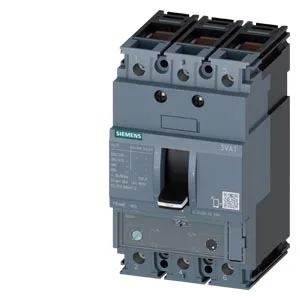
Ratings and what they decide
The 3VA1110-3EF36-0BA0: The 100 A rating holds from 40 °C through 50 °C; above that it derates to 98 A at 55 °C, 96 A at 60 °C, 94 A at 65 °C, and 91 A at 70 °C. That thermal curve matters when the breaker is packed into a warm enclosure — the 70 °C figure is the operating maximum, and the part's power loss is 27.5 W maximum, so panel ventilation or spacing may be needed to stay above the derated current. The interrupting ratings at 240 V (75.6 kA), 415 V (52.5 kA), 440 V (32 kA), 500 V (11.9 kA), and 690 V (11.9 kA) define the maximum fault current the breaker can safely clear at each voltage. For a site electrical engineer coordinating with upstream protective devices, the 75.6 kA at 240 V gives headroom on low-voltage secondary distribution; the 11.9 kA at 690 V is the limit for industrial systems at that level.
The 3VA1110-3EF36-0BA0 measures 130 mm high, 76.2 mm wide, and 70 mm deep — a compact 3-pole MCCB footprint that fits standard Siemens SENTRON panel-mounting cutouts. No trip indicator is fitted, so fault indication relies on the undervoltage release status or an external auxiliary contact.