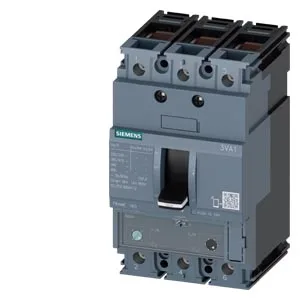
The Siemens SENTRON 3VA1110-3EF36-0JH0 is a 3-pole molded case circuit breaker (MCCB) rated for line protection, with a continuous current of 100 A at 40 °C and a breaking capacity of 75.6 kA at 240 V. At 415 V the breaking capacity is 52.5 kA, and at 690 V it holds at 11.9 kA, so the SCCR you coordinate depends on the system voltage.
Above that, it drops to 98 A at 55 °C, 96 A at 60 °C, 94 A at 65 °C, and 91 A at 70 °C. The 76.2 mm width (3 inches) is the standard 3-pole MCCB footprint — it will drop into a panel designed for a 3VA1010-2ED32-0JA0 or similar SENTRON frame without rewiring, as long as the busbar and lug positions match. Power loss is 25 W maximum at rated load. For a panel with multiple breakers, that heat adds up — factor it into your thermal budget if you're packing more than a few units in a sealed enclosure.
Auxiliary and trip options
The trip indicator and voltage trigger are present; undervoltage release is not fitted. No ground-fault monitoring version, no communication function — this is a pure line-protection device, not a power-monitoring breaker.