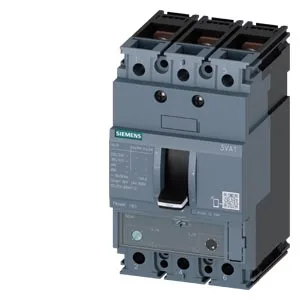
The Siemens SENTRON 3VA1110-4EF32-0AG0 is a 3-pole molded case circuit breaker (MCCB) designed for line protection, carrying a continuous current rating of 100 A at 40 °C and fitted with a TM240 thermal-magnetic release. Its interrupting capacity reaches 121 kA at 240 VAC, stepping down to 75.6 kA at 415 VAC and 52.5 kA at 440 VAC — figures that govern the available fault current the installation can handle without an upstream breaker.
Thermal derating — what the 100 A rating means in a warm panel
The 100 A rating holds flat from 40 °C through 50 °C, then steps down: 98 A at 55 °C, 96 A at 60 °C, 94 A at 65 °C, and 91 A at 70 °C. In a sealed enclosure with multiple breakers ganged, the 70 °C derated figure (91 A) is the one to design to — the breaker will not trip nuisance on a 90 A continuous load in that environment. The TM240 thermal-magnetic release uses a bimetal element for overload protection and a magnetic coil for short-circuit; the thermal curve follows the ambient inside the enclosure, not the control-room temperature.
Breaking capacity by system voltage — selectivity planning
The 3VA1110-4EF32-0AG0 delivers 121 kA at 240 V, 75.6 kA at 415 V, 52.5 kA at 440 V, and 11.9 kA at both 500 V and 690 V. The steep drop above 440 V means this breaker is primarily a 415 V / 440 V class device for high-fault installations; at 690 V the 11.9 kA rating limits it to lower-fault panels or requires a current-limiting upstream device for coordination.
The breaker measures 76.2 mm wide, 130 mm tall, and 70 mm deep — a 3-pole MCCB footprint that fits standard Siemens SENTRON mounting plates and busbar systems. The integrated auxiliary switch configuration (1 auxiliary switch + 1 trip alarm switch HP) provides status feedback and trip indication without an add-on module, saving a DIN-rail slot. The trip indicator is present on the front face for quick fault isolation during commissioning or troubleshooting.