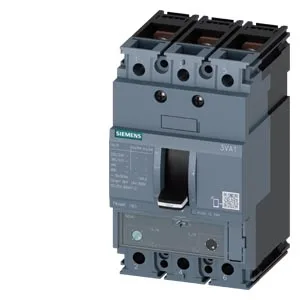
Siemens 3VA1110-4EF32-0KH0 — SENTRON MCCB, 100 A, 3-Pole, Line Protection
This line protection variant is designed for feeder and distribution duty in commercial and industrial panels, not for motor protection — the TM240 release curve is sized for cable and busbar protection, not for starting inrush. Breaking capacity is the headline spec here: 121 kA at 240 V, 75.6 kA at 415 V, 52.5 kA at 440 V, and 11.9 kA at 690 V. At 415 V, that 75.6 kA figure comfortably exceeds typical utility fault levels for a 400 V distribution board — you have headroom for selective coordination downstream without cascading upstream. At 690 V the capacity drops to 11.9 kA, which still covers most industrial motor-control-centre fault levels, but verify against your transformer impedance and cable run. Thermal derating is published per the datasheet: the breaker holds 100 A from 40 °C through 50 °C (–), then steps down to 96 A at 55 °C, 94 A at 60 °C, 92 A at 65 °C, and 90 A at 70 °C.
Fit and Mounting — Panel Integration
The 76.2 mm width is a standard 3-pole MCCB footprint — it occupies three 25.4 mm module positions on a DIN rail or direct-panel mount. Verify the depth clearance in your enclosure: 70 mm plus wiring space behind the breaker and clearance for the auxiliary contact wiring. The shunt trip release (STL) is integrated per the design, with the auxiliary trip module order code 3VA9688-0BL33. If your BOM calls for undervoltage release or phase failure detection, note that this variant carries neither. No communication function is fitted — this is a standalone electromechanical breaker, not a smart metering unit.
This is the mechanical endurance for the switching mechanism under no-load conditions; electrical endurance under rated load will be lower and depends on the switching frequency and fault-clearing history. For high-cycle applications (frequent switching of capacitor banks or motor circuits), consider the electrical endurance curve in the device manual.
Coordination and Selectivity Notes
Consult the Siemens selectivity tables for the 3VA series to confirm coordination with your specific downstream devices. The trip indicator provides local visual status of the breaker state — open, closed, or tripped. The voltage trigger function enables remote shunt-trip operation via the integrated STL release, which is wired to an external control voltage (typically 110–415 V AC/DC, per the shunt trip rating — verify the specific STL coil voltage against your control circuit).