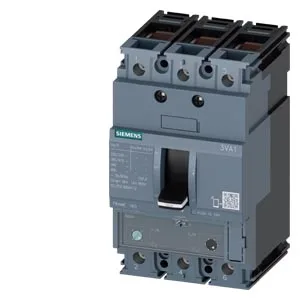
The Siemens SENTRON 3VA1110-4EF36-0HH0 is a 3-pole molded case circuit breaker rated for 100 A continuous current (Iu) at 40 °C, with a TM240 thermal-magnetic overcurrent release. The interrupting ratings tell the story: 121 kA at 240 V, 75.6 kA at 415 V, 52.5 kA at 440 V, and 11.9 kA at 690 V. The line protection version means this MCCB is configured for cable and busbar protection rather than motor protection — no adjustable overload class, no phase-failure detection. It's a straightforward thermal-magnetic curve for feeder circuits. The TM240 release is fixed thermal and magnetic, not electronic, so coordination studies are simpler but less flexible than the electronic versions in the same 3VA family. That gives you position indication for open/closed and a separate contact that closes only on a trip event — useful for remote alarm annunciation or PLC input without extra wiring. The shunt trip (STL) is integrated as the auxiliary release design, meaning a remote signal can trip the breaker for emergency stop or interlock schemes. The specific shunt trip module is 3VA9688-0BL30.
Thermal derating — the real-world current you get
Above that, it derates: 96 A at 55 °C, 94 A at 60 °C, 92 A at 65 °C, and 90 A at 70 °C. That's a 10% reduction, enough to nuisance-trip a fully loaded feeder. Factor the actual enclosure ambient into your load calculation, not just the nameplate 100 A. The storage limit is for handling and warehousing, not running.