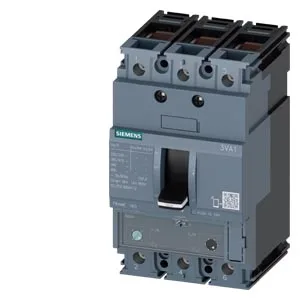
What this MCCB carries — and what it doesn't
The Siemens 3VA1110-4EF36-0JC0 is a SENTRON molded case circuit breaker (MCCB) rated for line protection — meaning it sits at the feeder or main branch, not on a motor circuit where overload curves and contactor coordination would be needed. It carries 100 A continuously at 40 °C ambient, derating to 91 A at 70 °C, so for a panel that runs warm you lose about 9 A off the top. The 3-pole design handles three-phase systems, and the 800 V rated insulation voltage (Ui) gives headroom for 480 V or 600 V class installations without derating the insulation path. Breaking capacity is the headline here: 121 kA at 240 V AC, 75.6 kA at 415 V, 52.5 kA at 440 V, and 11.9 kA at both 500 V and 690 V. That means on a 480 V panel (common in North America) the breaker can interrupt a 52.5 kA fault — enough for most industrial services with a transformer upstream. At 690 V the 11.9 kA figure still covers typical motor branch faults but won't handle a high-capacity utility feed at that voltage. This variant ships with a shunt trip (STL) and two auxiliary switches (HQ). The shunt trip lets a remote signal (e.g., E-stop, fire alarm, PLC output) trip the breaker electrically — useful for emergency-off circuits or remote load shedding. The two auxiliary switches give status feedback (open/closed) to a PLC or indicator lamp. No undervoltage release, no ground-fault module, no communication function on this order code.
Panel fit and mounting
The breaker measures 130 mm high, 76.2 mm wide, and 70 mm deep — a standard MCCB footprint for 100 A class. It mounts on a DIN rail or can be screw-fixed to a backplate. The 70 mm depth means it clears most 200 mm deep enclosures with room for wiring gutters. Power loss is 25 W maximum at rated load, so factor that into your thermal budget if the panel is densely packed. Operating temperature range is -25 °C to 70 °C; storage from -40 °C to 80 °C. That covers most indoor industrial environments, including unheated warehouses in winter. No derating needed for altitude or humidity is listed, but the standard IEC 60947-2 rules apply for installations above 2000 m.
