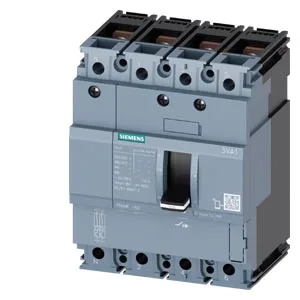
Breaking capacity hits 121 kA at 240 V and stays at 75.6 kA at 415 V, dropping to 52.5 kA at 440 V and 11.9 kA at both 500 V and 690 V. The 50 A fixed rating means it's sized for a specific load — a 50 A motor branch, a 50 A feeder, or a 50 A distribution submain — and you don't have to worry about an operator dialing it up past the wire rating.
Thermal derating — the real-world current you can carry
At 55 °C it derates to 98 A, at 60 °C to 96 A, at 65 °C to 94 A, and at 70 °C to 91 A. If your load pulls 55 A continuous and the ambient hits 65 °C, you're still inside the 94 A derated limit — no nuisance trips from ambient alone.
Built-in auxiliaries and accessories
That means you get remote tripping capability and status feedback out of the box — no separate accessory kit to order and install. The shunt trip lets a PLC or safety relay drop the breaker on a fault or E-stop signal. The trip alarm switch changes state when the breaker trips on overcurrent, giving a discrete input to the control system. No undervoltage release is fitted, so if you need UVR protection for a motor starter interlock, you'll add it externally. No communication module either — this is a standalone line-protection breaker, not a power-monitoring node.
Dimensions are 130 mm high, 101.6 mm wide, 70 mm deep — a 4-pole MCCB that fits a standard distribution panel footprint. Power loss is 25 W maximum at rated current, which matters for thermal management in a sealed enclosure.