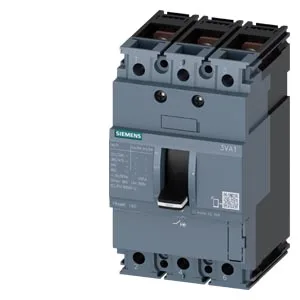
It carries 100 A continuously at 40 °C (derated to 91 A at 70 °C) and can interrupt 187 kA at 240 V AC, which means it handles high-available-fault-current service entrances or large distribution panels without cascading upstream. The TM210 thermal-magnetic trip unit gives you fixed thermal and magnetic settings — no adjustment dials, no calibration drift to chase.
The interrupting ratings span the voltage range you actually see in the field: 187 kA at 240 V, 121 kA at 415 V, 75.6 kA at 440 V, and 17 kA at both 500 V and 690 V. At 240 V that 187 kA figure is well above typical utility transformer fault levels — you get full selectivity with downstream breakers without worrying about the main tripping on a branch fault. At 690 V the 17 kA rating still covers most industrial motor-control-center bus faults.
Full 100 A rating holds through 50 °C ambient. At 55 °C it derates to 98 A, at 60 °C to 96 A, at 65 °C to 94 A, and at 70 °C to 91 A. That derating curve is gentle enough that a panel running at 50 °C ambient doesn't lose capacity. Maximum power loss is 25 W — modest for a 100 A frame, so heat buildup in a crowded enclosure is manageable.
Panel fit and auxiliary options
Dimensions are 130 mm high, 76.2 mm wide, 70 mm deep — a standard 3-pole MCCB footprint that drops into SENTRON distribution panels or DIN-rail adapter plates. The breaker ships without an undervoltage release or ground-fault module, but it accepts the 3VA accessory range for those add-ons. It comes configured with three auxiliary switches (HQ type) for remote status indication — handy for a BMS or PLC digital input without wiring extra contact blocks.