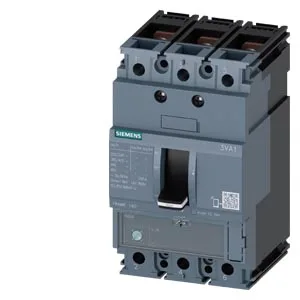
What this MCCB is and what it does
The Siemens SENTRON 3VA1110-5EE32-0CA0 is a 3-pole molded case circuit breaker (MCCB) rated for 100 A continuous current at 40 °C, with a TM220 thermal-magnetic release — meaning it uses a bimetal element for overload protection and a magnetic coil for short-circuit protection, no electronic adjustment. It is a line-protection version, so it is sized for feeder and distribution circuits, not motor-starting duty. The breaker carries a 187 kA interrupting rating at 240 V and 121 kA at 415 V, which means it can safely clear a fault up to those levels without upstream cascading — critical for high-fault panels near transformers or large drives. This MCCB includes an undervoltage release (UVR) as the auxiliary release type, so it will trip if the control voltage drops below a threshold — useful for safety circuits that need to drop the breaker on loss of control power. There is no auxiliary contact block fitted as standard, no ground-fault monitoring, and no communication module. The front face is rated IP40, so it is protected against tools and small solids but not against water ingress; mount it inside a panel, not exposed to washdown.
Thermal derating and panel fit
The 100 A rating holds flat from 40 °C to 50 °C — no derating needed in a typical 40 °C panel. Above that, it drops to 96 A at 55 °C, 94 A at 60 °C, 92 A at 65 °C, and 90 A at 70 °C. If your panel ambient runs hot (say, next to a drive cabinet), size the upstream conductor for the derated value, not the nameplate 100 A. The breaker body measures 130 mm high, 76.2 mm wide, and 70 mm deep — that 76.2 mm width is a standard 3-pole MCCB footprint for DIN-rail or screw-mount panels, so it drops into the same cutout as other SENTRON 3VA frames.
