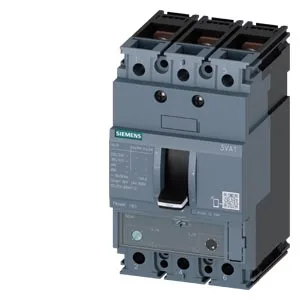
It lands in distribution panels, motor control centers, and feeder circuits where the line protection version handles overload and short-circuit faults without undervoltage or ground-fault monitoring.
Breaking capacity — the number that decides selectivity
This MCCB delivers 187 kA at 240 V, 121 kA at 415 V, 75.6 kA at 440 V, and 17 kA at 690 V. The 690 V rating drops to 17 kA, which still covers most 690 V motor circuits but needs a selectivity study if the available fault current exceeds that.
Thermal derating — don't size by the nameplate alone
At 55 °C it derates to 96 A, then 94 A at 60 °C, 92 A at 65 °C, and 90 A at 70 °C. A panel builder stuffing this into a high-ambient enclosure — say, a non-vented MCC bucket near a drive — must apply that curve. The TM240 release is adjustable for the long-time pickup, so you can fine-tune the trip point within the thermal-magnetic band without swapping the breaker.
Auxiliary contacts and status feedback
The trip indicator on the front gives the field service tech a quick visual check without needing a meter. No communication module, no phase-failure detection, and no undervoltage release are fitted on this variant.