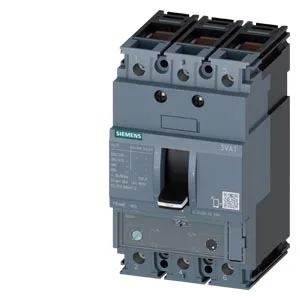
It's a 3-pole unit rated 100 A continuous at 40 °C, and it holds that rating all the way up to 50 °C before starting to derate — 98 A at 55 °C, 96 A at 60 °C, 94 A at 65 °C, 91 A at 70 °C. That thermal stability matters when the breaker lives in a crowded, hot panel. The interrupting ratings are the headline: 187 kA at 240 V, 121 kA at 415 V, 75.6 kA at 440 V, and 17 kA at 500 V or 690 V. Those numbers mean it can safely clear a bolted fault at the service entrance without rupturing, which is what you need for a high-capacity main breaker in a 480 V or 400 V industrial panel.
Overcurrent release and integration
The overcurrent release is a TM240 — a fixed thermal-magnetic trip with a 240 A frame rating, adjusted down to the 100 A continuous setting. There's no undervoltage release, no voltage trigger, no ground-fault monitoring, and no communication function built in. It's a plain-vanilla thermal-magnetic breaker for straightforward line protection. Front face carries IP40 protection. Power loss is 25 W max at rated load. Mounting dimensions: 130 mm tall, 76.2 mm wide, 70 mm deep — a standard 3-pole MCCB footprint that drops into most DIN-rail or panel-mount bases in the SENTRON family. If you're swapping out an older 3VA1 or 3VT breaker, check the lug kit compatibility; the mounting hole pattern is the same.