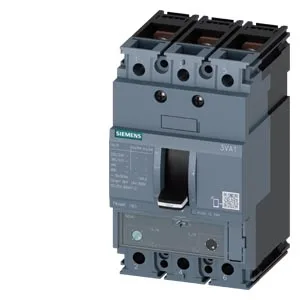
MCCB for high-fault plant feeders
Its headline breaking capacity is 220 kA at 240 V, stepping down to 154 kA at 415 V and 121 kA at 440 V — figures that put it squarely in the high-fault-duty class for main feeders or large distribution boards where upstream transformer capacity is high. For a 415 V plant bus, the 154 kA rating still covers most industrial service-entrance scenarios; the 17 kA at 690 V is a reminder that this is a 690 V-rated device but the interrupting capacity drops off at higher voltages — check your system's available fault current at the point of installation. The TM240 release is thermal-magnetic, so overload protection is thermal (inverse-time) and short-circuit protection is magnetic (instantaneous).
Current derating and panel fit
The 100 A rating holds flat from 40 °C through 50 °C ambient, then derates to 96 A at 55 °C, 94 A at 60 °C, 92 A at 65 °C, and 90 A at 70 °C. For a panel running warm — say 55 °C inside the enclosure — you lose 4 A of headroom; at 70 °C you lose 10 A. If your load is a full 100 A continuous, keep the ambient below 50 °C or step up one frame size. IP40 on the front face is typical for a panel-mounted breaker; the body itself is not sealed for washdown environments.