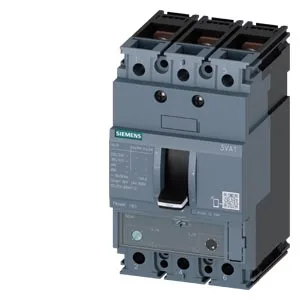
The 220 kA breaking capacity at 240 V means it can safely interrupt a fault current up to that level without welding contacts or cascading failure upstream; at 415 V the rating is still 154 kA, and at 690 V it holds 17 kA.
At 55 °C it drops to 98 A, at 60 °C to 96 A, at 65 °C to 94 A, and at 70 °C to 91 A. That's a common requirement for safety circuits or emergency-stop chains where loss of control power must open the main feeder. It also carries two auxiliary switches plus a separate trip-alarm switch (HQ), so you get position feedback and a dedicated signal for fault events without adding external relays.
Dimensions are 130 mm high, 76.2 mm wide, 70 mm deep — a standard 3-pole MCCB footprint that mounts on a DIN rail or directly to a backplate via screw terminals. The 70 mm depth (2.76 in) is the projection from the mounting surface; check clearance against the enclosure door or busbar shroud. The width of 76.2 mm (3 in) matches the typical 3-pole SENTRON frame spacing, so it drops into an existing panel layout without re-drilling.