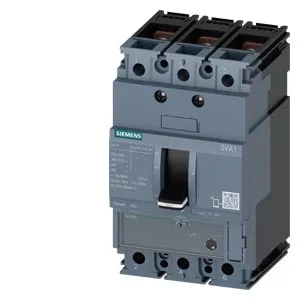
At 55 °C it still carries 98 A, at 60 °C it's 96 A, at 65 °C it's 94 A, and at 70 °C it's 91 A — so for a panel that runs warm, you keep nearly all the ampacity. At 240 V it interrupts 220 kA; at 415 V it's 154 kA; at 440 V it's 121 kA; at 690 V it drops to 8.5 kA. The 690 V figure (8.5 kA) tells you this is not a 690 V main breaker; it's a 480 V class device with a high-end short-circuit rating at the lower voltages where most industrial motor control centers operate. The basic switch inside this assembly is order code 3VA11106MH320AA0 — that is the core switching mechanism without the trip unit. For sourcing, if you need the full breaker as listed here, the 3VA1110-6MH32-0AB0 is the complete unit with the TM120M release and the auxiliary switches already installed.
The 70 mm depth fits most enclosures. Mounting is via the standard SENTRON clip or screw-mount kit (not included). The front-facing IP40 bezel protects the trip-unit adjustment dials and the handle mechanism. There is no trip indicator on this version — the breaker signals its state only through the handle position and the auxiliary switches.
What it replaces and what it does not
If you are replacing an older SENTRON 3VA1 frame breaker or a 3VA1110-5EE32-0DC0, this 3VA1110-6MH32-0AB0 shares the same physical footprint and the same 100 A frame. The key difference is the TM120M release (thermal-magnetic, fixed) versus the electronic release on the -5EE32 variant. The TM120M is a simpler, more rugged trip unit — no adjustment dials, no communication, no ground-fault option. It drops into the same panel without rewiring, but verify the trip curve matches your coordination study. The 3VA1010-4ED32-0AC0 is a smaller 100 A frame (different width) and is not a direct mechanical swap.