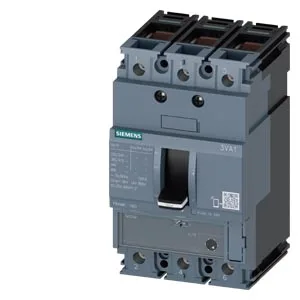
Siemens SENTRON 3VA1110-6MH36-0KH0 is a 3-pole molded case circuit breaker (MCCB) rated 100 A continuous, with a 154 kA interrupting capacity at 415 V AC — enough to handle high-fault utility feeds or transformer secondaries without cascading upstream. Designed as starter protection, so it's built to coordinate with contactors and overload relays in motor control centers, not just as a feeder breaker.
At 240 V the breaker clears 220 kA symmetrical; at 415 V it holds 154 kA; at 440 V it drops to 121 kA; above 500 V it's rated 7.5 kA. Below 500 V the ratings are extremely high for a 100 A frame; above 500 V the capability drops sharply, so don't use it for 690 V motor circuits expecting full fault discrimination.
Thermal derating — the real continuous current
At 55 °C it derates to 98 A, at 60 °C to 96 A, at 65 °C to 94 A, and at 70 °C to 91 A. The maximum power loss is 25 W, modest for a 100 A frame, so internal cabinet heating from the breaker itself isn't the derating driver.
Built-in accessories — shunt trip and auxiliary switches
The shunt trip allows remote tripping from an E-stop or PLC output — critical for emergency-off circuits. The trip alarm switch gives a separate signal when the breaker trips on fault, not just when it's manually opened.