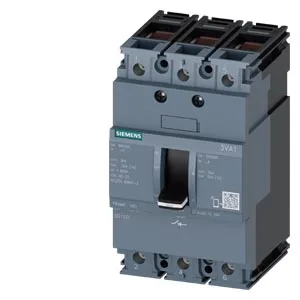
The Siemens 3VA1112-1AA36-0AH0 is a SENTRON switch disconnector in a molded-case circuit breaker (MCCB) form factor, rated for 125 A continuous current (Iu) on a 160 A frame. It provides visible isolation for a circuit — it switches load current on and off, but it does not include overload or short-circuit protection. That makes it a pure disconnect for maintenance isolation or load switching where upstream protection already exists. Rated for 690 V AC and 500 V DC, it handles both line and DC bus applications. The 3-pole unit uses front terminal connections.
The 125 A continuous rating (Iu) at 800 V insulation voltage (Ui) means this disconnect is sized for a 125 A feeder or motor branch circuit. The short-time withstand ratings — 2 kA for 1 s and 2 kA for 0.5 s — tell you it can pass fault current long enough for an upstream breaker to clear, but it is not rated to interrupt a fault itself. That is consistent with its role as a switch disconnector, not a circuit breaker. The trip alarm switch signals when the disconnect has been opened — useful for remote status monitoring on a motor control center or distribution panel. Maximum power loss is 38 W at rated current, which matters for thermal management inside a sealed enclosure.
That is the same 3-pole MCCB footprint as the rest of the 3VA1 160 A frame — drops into the same DIN-rail or screw-mount panel cutout as a 3VA1 circuit breaker. Front terminals accept lug or clamp connections (clamp connection per the description). The disconnect accepts an optional motor drive (product extension optional), so it can be remotely operated for applications like automated load shedding or remote disconnect.