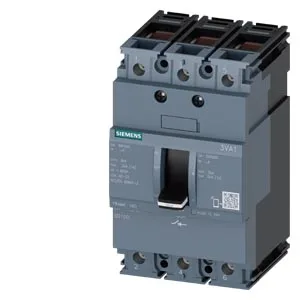
It is built as a pure disconnect device: no overload release, no short-circuit protection. That makes it a load-break switch for isolating a circuit under load, not a circuit breaker.
Rated continuous current Iu = 125 A is the maximum current the switch can carry continuously without exceeding thermal limits. That is the number you size against your load current. The rated insulation voltage Ui = 800 V and the maximum operational voltage with AC 50/60 Hz = 690 V tell you the switch can be used in 400 V or 690 V industrial networks — common in European and IEC-style panels. With DC, the max operational voltage is 500 V, so it also works in DC bus or battery circuits up to that voltage. The 2 kA limited short-time withstand (1 s and 0.5 s) means the switch can hold closed under fault current for that duration while an upstream breaker clears — coordination matters.
The 3VA1112-1AA36-0DA0 is a DIN-rail-mount device (width 76.2 mm, depth 70 mm, height 130 mm) — standard for enclosure mounting. Front terminal connection for the main circuit, so busbars or cable lugs land on the front face. The optional motor drive (product extension available) allows remote switching via a motor operator.