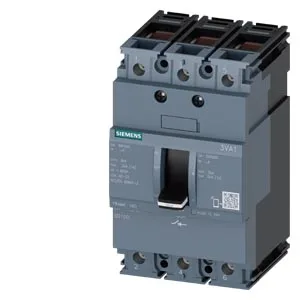
It provides no overcurrent or short-circuit protection — it is a pure isolating and switching device, sized for load-break duty on feeders or downstream of a protective device. The front-terminal clamp connection accepts up to 17 x 6.5 mm busbar or cable lugs, matching the standard panel layout for 3VA frame-160 breakers.
Shunt trip and auxiliary contact fit
That means it can be remotely tripped from a PLC or emergency-stop circuit without a separate undervoltage release — the STL fires on applied voltage, not on loss of power. The auxiliary contact set gives three CO contacts for status feedback to a control system or panel lamp. The same frame accepts a motor-drive option for remote motorized operation, though that is not included here.
Physical integration
The 76.2 mm width is three 25.4 mm module slots — standard for a 3-pole MCCB footprint on a DIN rail or panel-mount plate. Front terminal access keeps wiring accessible without removing the device.
Electrical ratings in context
Rated insulation voltage Ui is 800 V; maximum operational voltage is 690 V AC 50/60 Hz and 500 V DC. Short-time withstand current is 2 kA for 0.5 s and 1 s — this is the current the device can carry momentarily during a fault without welding contacts, not a breaking capacity. The switch disconnector is not designed to interrupt fault currents; it isolates the load after upstream protection has cleared the fault.