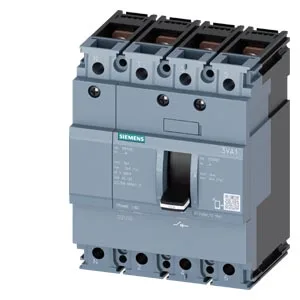
What this SENTRON switch disconnector is — and isn't
The Siemens 3VA1112-1AA42-0AB0 is a 4-pole switch disconnector in the SENTRON 3VA family, built on the IEC frame 160 platform with a rated continuous current Iu of 125 A. It is explicitly designed as a switch disconnector — not a molded case circuit breaker — meaning it provides no overload protection (no thermal or magnetic trip) and no short-circuit protection. Its job is safe isolation and disconnection under load, not fault interruption. The 4-pole configuration switches three phases and neutral.
The 125 A continuous rating (Iu) governs the maximum uninterrupted current the disconnector can carry without exceeding its thermal limits. This is the number that decides conductor sizing and upstream protection coordination — the disconnector itself does not clear faults, so the upstream breaker or fuse must be sized to protect the downstream cable and load. For a switch disconnector used primarily for infrequent isolation (maintenance lockout, process changeover), that's a long service life; for daily switching duty, consider a contactor or load-break switch instead. Power loss is 38 W maximum at rated current. The IP40 front-face protection covers the operator interface.
Dimensions are 70 mm deep, 101.6 mm wide, and 130 mm tall — the 101.6 mm width (4-inch nominal) is the 4-pole frame width on the SENTRON 3VA platform. The main current circuit connects via busbar connection at the front terminal, which means it's designed for horizontal busbar systems or pre-fabricated distribution bus. No box terminals on this variant; the busbar connection is fixed. The auxiliary contacts are wired via the front terminal block. Optional motor drive can be added via the product extension slot.