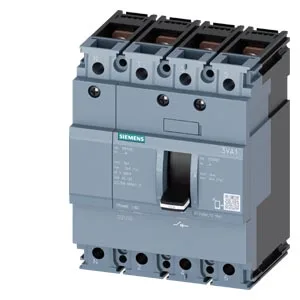
It carries no overload or short-circuit protection — this is a pure disconnect for isolation, not a circuit breaker. The front-terminal busbar connection and the four HQ auxiliary switches (4 CO contacts) make it a fit for panel builders who need a service disconnect with auxiliary signaling, not branch-circuit protection.
The 125 A continuous rating at the 160 A frame means this disconnect handles full-load current up to 125 A without derating in a 40 °C ambient — the frame itself has headroom, so terminal temperature rise stays within IEC limits at rated load. The busbar connection (front terminal) means the part is designed for direct plug-on busbar systems, not lug or cable termination — verify your panel's busbar pitch and finger configuration. The 70 mm depth, 101.6 mm width, and 130 mm height match the standard 3VA1 frame footprint, so it occupies the same DIN-rail or mounting-plate space as a 4-pole MCCB of the same frame.
Deployment context
This is a panel-mounted switch disconnector for isolating a load circuit — typically a motor feeder, a distribution sub-feed, or a machine supply — where the upstream protective device (MCCB or fuse) handles overcurrent, and this part provides visible isolation and auxiliary status contacts. The four HQ auxiliary switches can signal open/closed position to a PLC or indicate status on a mimic panel.