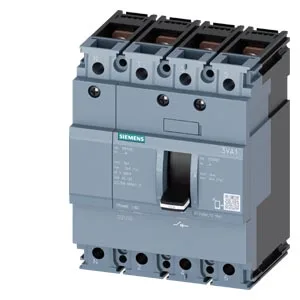
This is a load-break disconnect, not a circuit breaker — it has no overload or short-circuit protection elements built in. It is designed for manual isolation and switching of circuits where overcurrent protection is handled upstream or by a separate device. Rated operational voltage goes up to 690 V AC 50/60 Hz and 600 V DC, with an insulation voltage (Ui) of 800 V.
The 125 A rating is the uninterrupted current the disconnector can carry continuously without exceeding a 38 W maximum power loss. That 38 W is the heat you need to manage inside the enclosure — at 125 A steady load, the switch will dissipate that much.
Main circuit connections are via front-facing busbar terminals — the busbar connection type means it is designed to bolt directly onto a busbar system inside the panel, not to accept lugged cables. A nut keeper kit is included for the busbar mounting hardware.
That part provides both overload and short-circuit protection (LI characteristic) and has a higher interrupting capacity — up to 187 kA at 240 V. The 3VA1112-1AA42-0AH0, by contrast, is a switch disconnector with no trip unit and no overcurrent protection. It is the correct choice when the protective function is already covered upstream and only a visible-break isolation switch is needed. It will not drop into a panel designed for the 3VA2116 without rewiring: the 3VA1112 is 4-pole versus the 3VA2116's 3-pole, and the busbar connection arrangement differs.