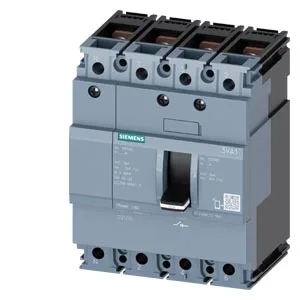
That 125 A holds steady at 40 °C, 50 °C, even 70 °C, so it's sized for a warm enclosure or a high-ambient panel without having to oversize the frame. Four poles, rated insulation voltage 800 V, and it handles AC up to 690 V or DC up to 600 V. The front terminals accept busbar connection, and the IP40 front face keeps dust and accidental contact out of the live compartment.
The busbar connection on the main circuit and front terminals mean you land the bus bars from the front, which simplifies bus stacking in a distribution section. It ships with two factory-installed HQ auxiliary switches (form C) and an undervoltage release (UVR) coil for 24 V DC. The UVR drops the switch on loss of control voltage — standard for emergency-off or undervoltage protection schemes. No communication module inside; this is a pure disconnect, not a smart breaker.
Power loss runs 38 W maximum at rated load — worth accounting for in enclosure thermal calculations if you're packing several of these in a small cabinet. Mechanical service life is 15,000 operating cycles typical, so it's built for occasional switching, not continuous motor-start duty.
The 3VA1112-1AA42-0BC0 is a switch disconnector, not a circuit breaker — it has no overload or short-circuit protection. The "SD100" in the description confirms it's a disconnect-only variant. If you need integrated protection, you'd step up to the 3VA1 MCCB with a trip unit. This part is for isolation and switching under load, with the UVR providing the only automatic trip on loss of control voltage.