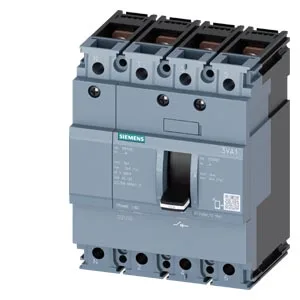
The Siemens 3VA1112-1AA42-0BH0 is a SENTRON 3VA1 switch disconnector in an MCCB design, rated for 125 A continuous current across the full operating temperature range from 40 °C to 70 °C — no derating needed up to that ceiling. It is a 4-pole unit (SD100) with no overload or short-circuit protection built in, so it functions purely as a disconnect and isolation device, not a circuit breaker. The UVR includes no leading contact, so it drops out immediately on voltage loss below the release threshold.
What the 125 A rating means for fit
The insulation voltage is rated at 800 V, with operating voltage at 690 V AC or 600 V DC, so it handles 480/600 V industrial feeds comfortably. Because it carries no overcurrent trip elements, it is sized purely for the load current and fault-withstand capability of the downstream protection. Use it where a visible break and lockout isolation are required ahead of a fused or breaker-protected branch — typical for motor disconnects or panel main switches where the upstream device handles the fault interruption.
Front terminal connections for the main circuit, busbar-compatible. Dimensions are 70 mm deep by 101.6 mm wide by 130 mm tall — fits a standard 4-pole MCCB footprint on the DIN rail or panel-mount plate. Mechanical service life is 15,000 operating cycles typical. Optional motor drive can be added for remote switching. The auxiliary switch complement (2 HQ + 1 trip alarm) gives status feedback for PLC or indication circuits without an add-on module.